|

|
|
|
WORLD HERITAGE SITES IN PORTUGAL
SINTRA
SINTRA
Sintra is one of those magical places where man and nature come together in a perfect symbiosis, as if wishing to leave us in a state leave of permanent surprise, enraptured by the beauty of their joint efforts. Known in ancient times as Mons Lunae (the Hills of the Moon), because of its strong traditions of astral cults, still clearly visible in the region's countless monuments and archaeological remains, the Serra de Sintra is a granite outcrop roughly 10 km long, rising abruptly between a vast plain to the north and the estuary of the River Tagus to the south. It is a mountain range that twists and turns, projecting into the Atlantic Ocean to form Cabo da Roca - the headland that marks the westernmost point of' continental Europe.
Cherished and revered over so many years, the Serra de Sintra today contains a fabulous collection of monuments from a whole host of different epochs, ranging from prehistoric times to the present day. This is a clear demonstration of the region's great respect for other people and its enormous cultural tolerance. Almost as important as the diversity of the monuments is the tremendous environmental wealth of the Serra. Thanks to its unique microclimate, Sintra has some of the most beautiful parks in Portugal, planted in keeping with a certain romantic taste, as well as a dense and verdant natural vegetation, affording the region an air of great majesty amidst the splash of different greens.
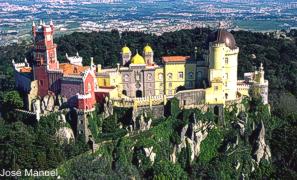
The visitor can therefore choose between descending into the Neolithic era at Tholos do Monge; enjoying the view of the distant horizons from the walls of the Castelo dos Mouros, an eighth-century Moorish defensive construction; experiencing the harsh austerity of the Franciscan monks of the Convento dos Capuchos; strolling through the delightful mysteries of the Palacio da Pena, a mythical and magical palace that seems more like a continuation of the actual mountain; or savouring the nooks and crannies of the Parque da Pena, a place of love and exoticism that exudes great peace and serenity.In view of their ancient and heterogeneous quality, the group of buildings forming the region's so-called historical centre offers the visitor a fascinating trip into the human past, a chance to feel and admire the different ages that have provided so much history.
The town of Sintra still retains its essentially medieval layout, with narrow and labyrinthine streets, steps and arcades. It is, however, dominated by the Palacio Nacional, its main architectural feature and the most fascinating regal construction in Portugal. This is a palace that was not created just once nor in just one period, but instead is the result of a harmonious and seductive assembly of different parks, built in successive phases and in a variety of styles. And it is these multiple tastes and mentalities that have - largely contributed to the strange beauty of this palace. Amongst its different phases of building work, perhaps the most notable are the two great periods that gave the palace both its shape and character: the one led by D. Joao I in the first third of the fifteenth century and then, a century later, in the first quarter of the sixteenth century, the one that took place in the reign of D. Manuel I.
The palace has been the setting for countless important events in national history. It was here that D. Afonso V was born and died; D. Joao II was proclaimed king; D. Manuel I received the news of the discoveries of India and Brazil; D. Sebastiao departed to fight the ill-fated battle of Alcacer Quibir; and the unfortunate D. Afonso VI was so sadly imprisoned. This palace was the preferred residence for royal leisure seekers, simultaneously serving as a centre for their recreation and learning. Inside the palace, the bucolic poet Bernardim Ribeiro could be seen strolling regularly through its rooms, whilst the playwright Gil Vicente performed here, Joao de Barros engaged in his writings, and Camoes probably read his Lusiadas to D. Sebastiao for the first time.Amidst the palace's labyrinthine and surprising collection of rooms, courtyards, staircases, corridors and galleries, one of the most notable features is what amounts to the largest and richest set of Mudejar azulejos to be found in the Iberian Peninsula. In view of the peculiarly peninsular quality of this type of ceramic covering, this is equivalent to saying the richest and largest collection of such tiles in the world.
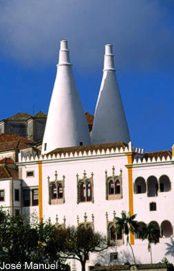
Visitors will feel as though they have entered a Moorish palace, the kind of which fairy tales are made. They will stare in wonder at the ceiling of the Sala dos Cisnes (Swans' Room), which reminds us of the marriage of the InFanta D. lsabel of Portugal to Philip the Good, Duke of Burgundy, marvel at the somewhat malicious revival of medieval legends in the Sala das Pegas (Magpie or Reading Room), and gasp in admiration at the fantastic Sala dos Brasoes (Armoury), its glorious ceiling decorated with the coats of arms of the Portuguese nobility and its floor worn away by the continuous striding back and forth of D. Afonso VI, incarcerated in this room for the last nine years of his life. And, as they leave the palace, they cannot fail to cast one last admiring glance from the inside at the huge conical chimneys of the monks' kitchen, the best known and defining landmark of the town of Sintra.
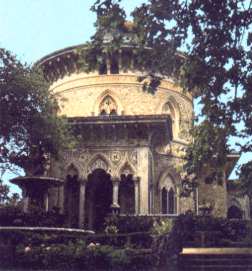
The historical centre does, however, contain other monuments of great dignity and interest that should also be admired: the Torre do Relogio (clock tower), Igreja de Sao Martinho, Paco dos Ribafria, Convento da Trindade, Igreja de Santa Maria, a remarkable series of ancestral fountains, such as the Fonte da Pipa and the Fonte da Sabuga. And it is also worth paying an attentive visit to the Jewish quarter, a group of houses inhabited by the followers of the Laws of Moses.On the outskirts of the town are some of most beautiful and important creations of the Romantic movement. At the top of the Serra stands the nineteenth-century Palacio da Pena, the delightful product of the dreams of an artist king, D. Fernando, whilst at the foot of the mountains magnificent chalets are to be found scattered here and there, as well as small palaces such as the neo Oriental Monserrate, surrounded by its exuberant and exotic park and constituting a genuine botanical museum, and large stately homes, such as the Quinta do Relogio, with its neo-Moorish palace, or the Quinta da Regaleira, carrying us back to the world of initiatory symbols. All this is finally, a brilliant revivalist cycle that completely transformed the Sintra landscape in a most remarkable and seductive fashion.
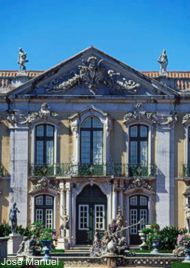
In I924, a sophisticated casino was built with all the delightful atmosphere created by Art Nouveau for the entertainment and enjoyment of the elite of the recently-formed Republican bourgeoisie. This remained a great tourist attraction in Sintra until it disappeared in 1938. Today, the beautiful building of the former casino houses a magnificent collection of contemporary art.
For all these reasons, plus the freshness of the region's pure air, the mists of its indescribable mystery and its vibrant culture, the great variety of its organised events - a special mention here for the Music Festivals and Ballet Nights organised in the summer - Sintra is still very much as it was once described by Robert Southey: ''the most blessed place in the whole of the inhabitable world''.
Text provided by the Portuguese Tourist Office