|

|
|
|
WORLD HERITAGE SITES IN PORTUGAL
TOWER OF BELEM
TORRE DE BELEM
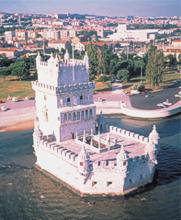
The Torre de Belem is a beautiful and original monument, unrivalled in the whole world. Its harmonious and distinctive shape is sharply outlined against the sky and the water of the River Tagus, and the delicate decoration of its stone suggests to those who feast their eyes upon it the appearance of a finely carved jewel. It was, however, seen differently by those living at the time of its construction, for whom the tower was a formidable and fearsome defensive fortress at the entrance to the river estuary, which was the function that its founder D. Manuel I had intended for it. 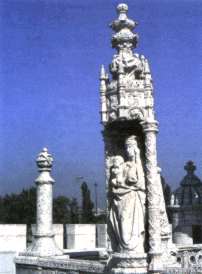
As happens with the nearby Mosteiro dos Jeronimos, the memories evoked by the Torre de Belem are associated with the era of the Discoveries. Belm is an area that is full of memories from Portuguese history, for it was also from here that Gago Coutinho and Sacadura Cabral took off in their sea plane Lusitania in 1922, heading for Rio de Janeiro to complete the first ever air crossing of the South Atlantic. The tower was built on a basalt island located close to the right bank of the Tagus, opposite the beach at Restelo, but, with the progressive southward creeping of the shore over the years, it is now practically ''moored'' to the bank itself. Construction began in 1514 under the supervision of the architect Francisco de Arruda. By 1520, it was complete, and ever since then it has remained for posterity as one of the world's most beautiful examples of military architecture.The Torre dc Belem was an essential part of the defensive system for the mouth of the River Tagus, providing crossfire with the fortress of Sao Sebastiao da Caparica on the south bank. It consists of a quadrangular tower reminiscent of the keeps of mediaeval castles and a polygonal bastion, itself a fine example of the period's advanced defensive technology, being designed to support heavy artillery, with embrasures shaped rather like hatchways reaching almost to sea level.
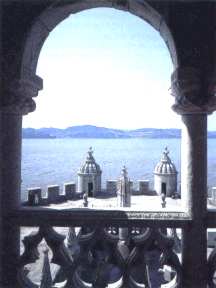
The sentry posts on each corner of the bastion are crowned by melon domes, denoting the influence of the style that was used in fortifications in Morocco, where Francisco de Arruda worked and certainly sought inspiration. Apart from these oriental features, the predominant decoration used in the tower is Manueline, as seen in the stone rope that encircles it, the heraldic motifs and even the famous rhinoceros, the first sculpted stone representation of this animal in Europe. The tower's most decorative side is the one facing south. Along this runs the loggia, with its finely carved limestone balustrade. Above the loggia are the shield of D. Manuel I and the armillary spheres.On the wall of the small cloister built into the terrace of the bastion is an 18th century statue of the Virgin and Child, Our Lady of Safe Homecoming, crowned by a canopy.
Once inside the tower, which is composed of several rooms, it is well worth making the effort to climb up to the top storey, from where you will be rewarded with a remarkable panoramic view that takes in the wide river estuary and the western part of the city of Lisbon, all of which is so evocative of' this period in Portuguese history.
Text provided by the Portuguese Tourist Office